Rigid Project Management is a logjam (and what to do instead)

Rigidity causes roadblocks that don’t need to exist -
We’ve all seen it—projects getting bogged down not by the work itself, but by the endless layers of approvals, processes, and rules. The tools meant to help are getting in the way.
Here’s the truth:
🧭 The best project leaders today are adapting. They’re not throwing away frameworks—they’re customizing them. They’re prioritizing people, clarity, and real progress over rigid protocol.
Want the highlights?
Breaking one “rule” boosted project velocity
Adaptable frameworks drive better results
The one status report I never write (and why)
Breaking one rule - If you caught yesterday's post, you'll remember that this was a global project. We had global deadlines with regional schedules. But, some of the compliance pieces didn't take into consideration the difference in the work between the regions. It's difficult to use the same field headers for vastly different businesses. Some of the compliance in gating wanted full PMO Exec sign-off, but the process only stated that one needed to be included in the documentation. So...
Did I report on all the field names?
Sure. They were full of NA. Did I get one Exec sign-off instead of waiting for the delayed PMO Board Review that would have made me miss deadlines? You betcha. And documented the heck out of it. (I guess that's technically two rules broken.)
What would have worked better?
Adaptable Frameworks - At this point we're all familiar with Agile approaches to work. But, back when this project happened? Most of the PM approach was firmly set in the traditional structure. I'm a big fan of a Hybrid approach, myself and I think it would have helped this project significantly. Yes, have a planned out waterfall approach for when milestones should be hit, when rollouts should happen regionally, but also allow for work to be completed more fluidly when it makes sense.
Field names - how about having core financial fields required, but offer pools of fields based on business type? It's going to yield more useful reporting than a bucket of NAs.
Gated checkpoints - still useful, but maybe consider engaging smaller Regional Teams to provide guidance and approvals to take back to the HQ PMO Board. Keep things moving locally.
Work being completed more fluidly - Why should I wait until the first gate meeting is done to start spaghetti-charting the next major process issue? Whether we have additional work to do or not on the last gate is independent of this investigation. And getting work done is better than not, yes? (Dang, I guess I'm at three rules broken.) If this project were done today, you can bet that it would be done as a Hybrid. We've learned a lot over the last couple of decades and it's better for everyone. We still do get hung up on status reports though...
One status report I never write - If there is no change on a project, I no longer write a full status report. It's a waste of time for me, for the clients, and for any executives on either side. Instead, I write an explanation statement with a pick-up date.
I.e. No tasks were scheduled for completion during this reporting interval. Progress is as expected. Next task / milestone is due xx/xx/xxxx. OR Tasks were not completed this week due to unexpected illness on client team. Mitigation meeting scheduled for xx/xx/xxxx to discuss schedule resolution.
If you're looking for methods of introducing flexibility into your Project Management Structure, here's a few approaches to investigate:
Disciplined Agile for blended Agile approaches
SAFe (Scaled Agile Framework)
PRINCE2 Agile
AgilePM
I'm a PMP through PMI. My blended approach calls for components of traditional Project Management, including governance boards and one over-arching schedule. However, the underlying work is scheduled and completed using an Agile approach = work is delivered iteratively for continued progression, allowing for minor tweaks to enter the schedule as part of the gated reviews. Here's an example of how this might look -
Project: Development of a cloud-based HR onboarding system
Context:
A mid-sized enterprise wants to improve employee onboarding.
The CIO prefers predictable timelines and budgets.
The development team wants to use Scrum for faster feature releases.
How PMI's Five Process Groups Work with Agile Delivery
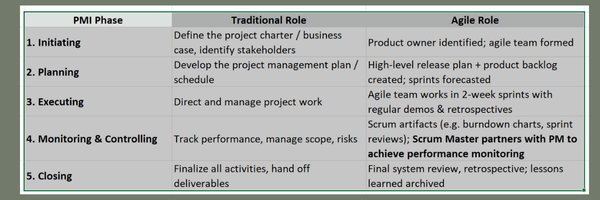
By combining PMI structure with Agile delivery:
The PM ensures stakeholder alignment, risk management, and contract obligations.
The Agile team delivers value every sprint, adapting to user feedback.
Progress is reported in PMI terms (earned value, milestones), but work is done iteratively.
📍 If you’re tired of doing things “by the book” when the book isn’t helping—you’re not alone.
📥 Want to talk about simplifying project management at your org? Drop me a line
👉 Let’s build better projects—together.

Find me on LinkedIn

support@wolfdiversified.com
Subscribe to our weekly newsletter for insights on project management, technical strategy, and leadership. Instantly get our free guide: the 7 problems we’re most often called in to fix — and what you can do about them.