
Where AI Actually Helps Teams Thrive
AI conversations are everywhere right now. There is:
Some excitement
Some anxiety
And a lot of mixed messaging
Here’s our perspective:
AI shouldn’t replace strong teams.
It should help clarify work so those teams can thrive.
When used well, AI reduces friction.
When used poorly, it accelerates confusion.
Today we wanted to share a practical breakdown of where we’re seeing it genuinely help organizations. This is not a doom & gloom, sky is falling message. This is simply a short guide of where - and how - you can start.
Nervous? A Realistic Reframe -
Most people already trust AI every day — it gets them home faster (Google or Apple Maps), filters their email (spam filters) and organizes their calendars (slot availability suggestions), and suggests their next favorite show (Netflix recommendations).
At work, it can do the same thing: reduce friction so people can focus on what matters.
Here we go.
1 - Data Investigation & Insight Support
AI is excellent at identifying patterns quickly:
Summarizing large datasets
Flagging anomalies
Highlighting trends leadership might miss
This speeds analysis, but does not assign meaning. You still need the expertise of your teams to dig into and understand why there were anomalies. Mistake in data entry? System outage that caused issues for one particular day? Process breakdown?
Is that trend valid or is AI combining data from two fields that don't actually correlate?
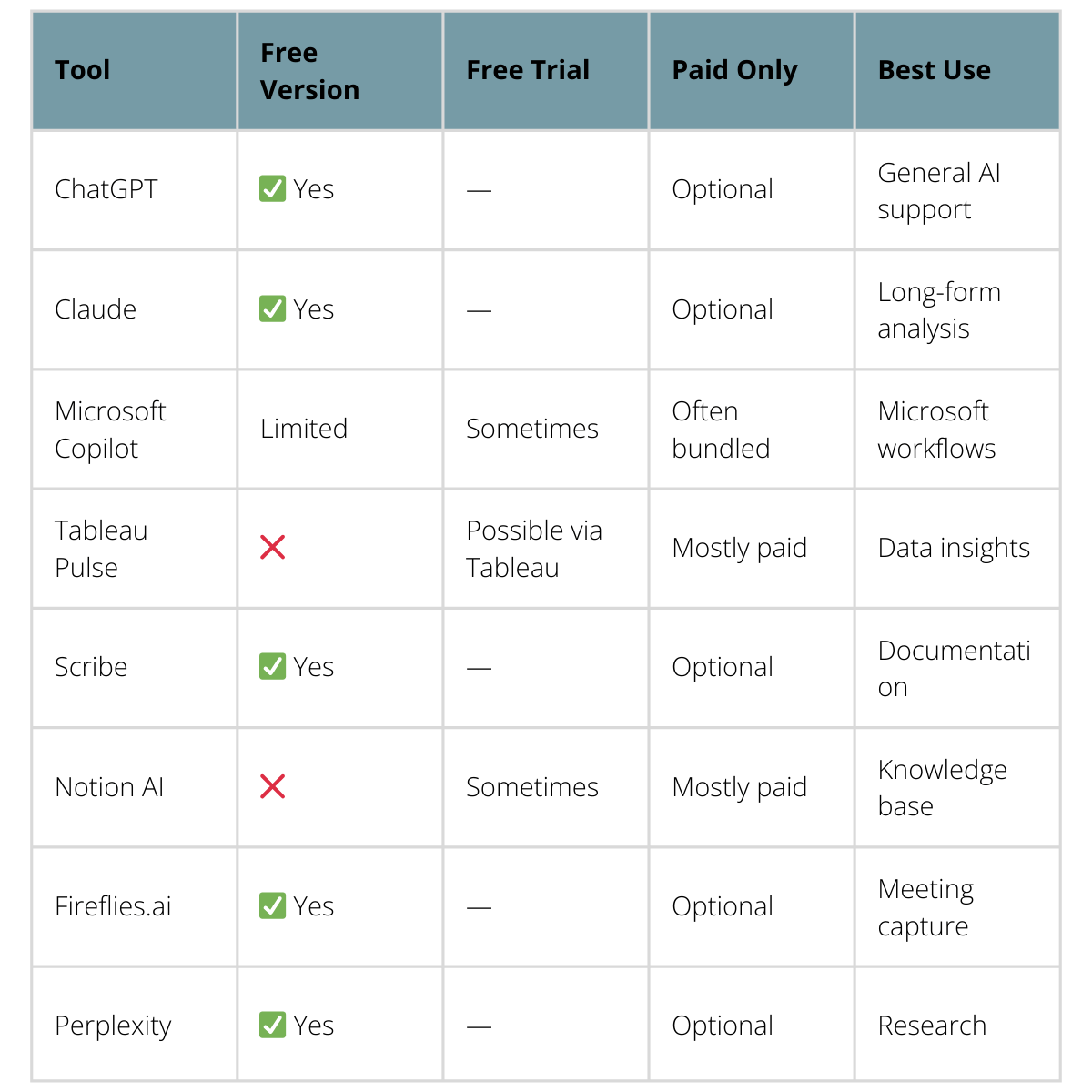
Tools worth exploring:
• ChatGPT / Claude — exploratory analysis and summaries
• Microsoft Copilot — especially inside existing Microsoft ecosystems
• Tableau Pulse (emerging AI features) — insight surfacing
The key: humans still interpret the meaning.
2 — Documentation & Knowledge Capture
This is often the fastest win.
Clear documentation reduces risk, accelerates onboarding, and protects institutional knowledge. Documentation continuity protects investments and keeps projects moving.
AI can help:
Draft SOPs
Convert meetings into usable notes
Capture technical workflows
Maintain clearer operational records
One standout tool here:
Scribe — excellent for automatically generating process documentation from real workflows
This is one of the simplest ways to reduce single-point dependency on key team members.
(What does this mean? It means if Bob is thrown from his snowmobile after crashing into a tree and is in full traction for three months, other people in the office can help cover his work because it's been documented in an easy to follow along format.)
The key: Humans are your information powerhouse. Documenting your strongest source of success creates operational resilience.
3 — Decision Preparation (Not Decision Replacement)
AI is excellent at organizing information before decisions are made.
Comparing options
Highlighting potential risks
Summarizing complex inputs
Providing Structure for strategic discussions
But - treat AI as a thinking partner - not the final authority.
AI informs decisions with the data it surfaces.
It shouldn’t own them because...
The key: Human context and experience are essential for making qualified judgements.
Where We See Organizations Struggle
Interestingly, when companies say AI isn’t delivering value, the root cause usually isn’t the technology.
It’s operational clarity.
Common underlying issues include:
First of all - there is stress in this change, but underlying this stress...
Processes aren’t fully defined
Priorities aren’t visible or are competing
Teams lack shared clarity (unclear ownership / communication gaps)
AI assists in making those gaps easier to see.
And that visibility can be incredibly helpful — especially when supported by technical consulting, fractional leadership resources, or structured project management.
Because strong teams don’t need replacing.
They need the right support.
💬 Your Turn
Have you found any hidden gem ways to use AI that have grown your team productivity? We'd love to hear!
If you’re exploring AI and want to ensure it supports clarity rather than chaos, that’s exactly the kind of work we do.
Quick Guide


Find me on LinkedIn

support@wolfdiversified.com
Subscribe to our weekly newsletter for insights on project management, technical strategy, and leadership. Instantly get our free guide: the 7 problems we’re most often called in to fix — and what you can do about them.